Category Archives: Comment of the Week

SOX Certifications – A Quarter-End Reminder

While it might seem a bit simplistic, errors in the SOX 302 certifications are a frequent yet very avoidable comment from the SEC.

Twist Bioscience, which has a September 30 fiscal year end, included the following language in its SOX 302 certifications in its Form 10-Q for the quarter ended December 31, 2025, and filed on February 2, 2026:

Certification of Principal Executive Officer pursuant to

Exchange Act Rules 13a-14(a) and 15d-14(a), as adopted pursuant to

Section 302 of the Sarbanes-Oxley Act of 2002

I, Emily M. Leproust, certify that:

1.I have reviewed this Annual Report on Form 10-K of Twist Bioscience Corporation for the year ended December 31, 2025;

2.Based on my knowledge, this report does not contain any untrue statement of a material fact or omit to state a material fact necessary to make the statements made, in light of the circumstances under which such statements were made, not misleading with respect to the period covered by this report;

(Balance of certification omitted for this blog post)

Clearly, the first part of paragraph 1, referring to Form 10-K and the year ended December 31, 2025, is an error in this Form 10-Q.  This resulted in the following comment from the SEC in a letter dated February 19, 2026:

Form 10-Q for the Quarterly Period Ended December 31, 2025

Exhibits

    1. We note the certifications provided in Exhibits 31 and 32 refer to the incorrect form and period. Please file a full amendment to your Form 10-Q with corrected certifications that refer to the proper form and period. Refer to Item 601(b)(31) and (b)(32) of Regulation S-K and Regulation S-K C&DI 246.14.

Because of the importance of the certifications, this is almost always a “please amend” comment.  In this example, the company did in fact amend its Form 10-Q.

To avoid this kind of situation, careful proofreading is all that is required.

As always, your thoughts and comments are welcome!
Yes, the SEC Does Follow Up on Comment Responses!

In our workshops and conferences, we emphasize that when a company states it will change its disclosure in future filings in response to an SEC comment, the CorpFin staff will review the company’s future filings to ensure that the company has made the requested changes.  We also discuss how the form of the certifications is a frequent “please amend” comment.

In its Form 10-K for its fiscal year ended November 30, 2022, BestGofer Inc. used this language, including three subparagraphs, for paragraph 4 in its CEO and CFO certifications:

  1. The issuer’s other certifying officer(s) and I are responsible for establishing and maintaining disclosure controls and procedures (as defined in Exchange Act Rules 13a-15(e) and 15d-15(e)) and internal control over financial reporting (as defined in Exchange Act Rules 13a-15(f) and 15d-15(f) for the issuer and have:

(a) designed such disclosure controls and procedures, or caused such disclosure controls and procedures to be designed under our supervision, to ensure that material information relating to the issuer, including its consolidated subsidiaries, is made known to us by others within those entities, particularly during the period in which this report is being prepared;

(b) evaluated the effectiveness of the issuer’s disclosure controls and procedures and presented in this report our conclusions about the effectiveness of the disclosure controls and procedures, as of the end of the period covered by this report based on such evaluation; and

(c) disclosed in this report any change in the issuer’s internal control over financial reporting that occurred during the issuer’s most recent fiscal quarter (the small business issuer’s fourth fiscal quarter in the case of an annual report) that has materially affected, or is reasonably likely to materially affect, the small business issuer’s internal control over financial reporting; and

While hopefully none of us have had to memorize the certification language, a quick look at Regulation S-K Item 601(b)31(i) shows us that paragraph 4 should contain these four subparagraphs:

  1. The registrant’s other certifying officer(s) and I are responsible for establishing and maintaining disclosure controls and procedures (as defined in Exchange Act Rules 13a-15(e) and 15d-15(e)) and internal control over financial reporting (as defined in Exchange Act Rules 13a-15(f) and 15d-15(f)) for the registrant and have:

(a) Designed such disclosure controls and procedures, or caused such disclosure controls and procedures to be designed under our supervision, to ensure that material information relating to the registrant, including its consolidated subsidiaries, is made known to us by others within those entities, particularly during the period in which this report is being prepared;

(b) Designed such internal control over financial reporting, or caused such internal control over financial reporting to be designed under our supervision, to provide reasonable assurance regarding the reliability of financial reporting and the preparation of financial statements for external purposes in accordance with generally accepted accounting principles;

(c) Evaluated the effectiveness of the registrant’s disclosure controls and procedures and presented in this report our conclusions about the effectiveness of the disclosure controls and procedures, as of the end of the period covered by this report based on such evaluation; and

(d) Disclosed in this report any change in the registrant’s internal control over financial reporting that occurred during the registrant’s most recent fiscal quarter (the registrant’s fourth fiscal quarter in the case of an annual report) that has materially affected, or is reasonably likely to materially affect, the registrant’s internal control over financial reporting.

Interestingly, the company omitted paragraph b above addressing ICFR. (That paragraph is bolded and underlined above.)

In a comment letter dated May 25, 2023, the SEC made this comment:

Form 10-K for the Fiscal Year Ended November 30, 2022

Exhibits 31.1 and 31.2

    1. Please revise the Rule 13a–14(a)/15d–14(a) certifications (Exhibit 31) in your Forms 10-K and 10-Q going forward to also include the language in paragraph 4(b) of Item601(b)(31)(i) of Regulation S-K. Please show us an example of what a revised Exhibit 31 will look like.

The company’s response dated June 8, 2023, indicated that the company would include the required language in future filings.

While a company might hope that this would be the end of the story for a comment like this, the staff does indeed follow up to ensure companies keep their commitments in future filings.  Unfortunately, BestGofer Inc. did not include this required language in a later Form 10-K, which lead to this “please amend” comment in a letter dated June 25, 2025:

Form 10-K for the Fiscal Year Ended November 30, 2024

Item 15. Exhibits, Financial Statement Schedules

Exhibits 31.1 and 31.2, page 12

    1. Your June 8, 2023 response to comment 1 in our letter dated May 25, 2023 indicated you would revise your Exhibit 31 certifications in future Forms 10-K and 10-Q to also include the language in paragraph 4(b) of Item 601(b)(31)(i) of Regulation S-K. However, you have not done so. Please amend your Form 10-K for the fiscal year ended November 30, 2024 and your Form 10-Q for the period ended February 28, 2025 to include revised Exhibit 31 certifications containing the language precisely as set forth in Item 601(b)(31)(i) of Regulation S-K. Also, ensure future Forms 10-K and 10-Q include the correct language in the Exhibit 31 certifications.

As always, your thoughts and comments are welcome!

An SEC Comment on a Control Deficiency

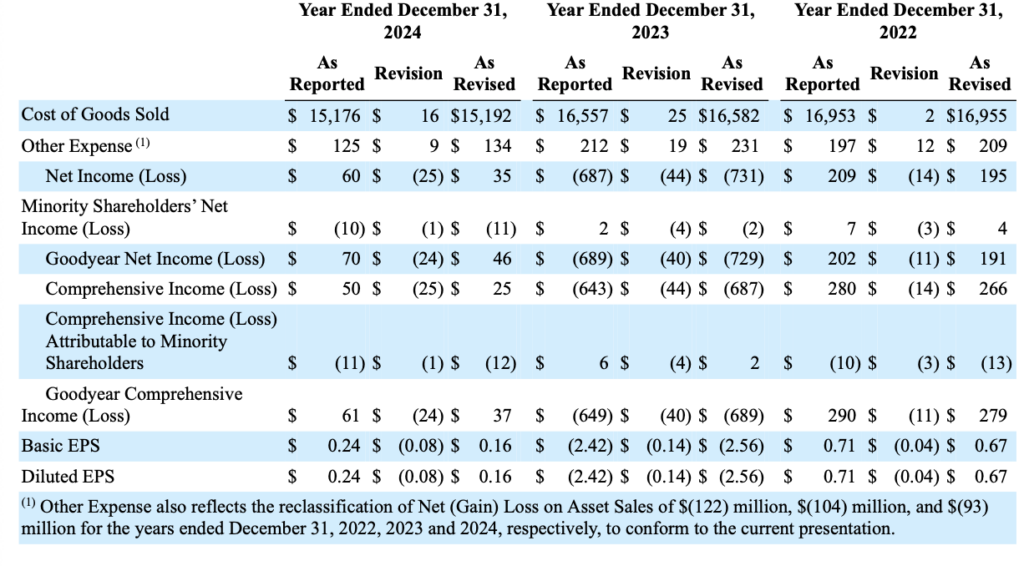
In its Form 10-Q for the quarter ended June 30, 2025, The Goodyear Tire & Rubber Company disclosed that it had identified errors in its previously issued financial statements related to the historical currency remeasurement of its operations in Turkey, which had been designated a highly inflationary economy beginning April 1, 2022:

NOTE 16.  REVISION OF PREVIOUSLY ISSUED FINANCIAL STATEMENTS

As discussed in Note 1, in preparing the consolidated financial statements as of and for the three and six months ended June 30, 2025, we identified errors in our previously issued financial statements related to our historical computation of currency remeasurement of our foreign operations in Turkey, which was designated as a highly inflationary economy beginning April 1, 2022. The identified errors impacted our previously issued 2022, 2023 and 2024 annual and interim financial statements. The impact of the errors on the previously issued consolidated statements of operations and comprehensive income for the quarter ended March 31, 2025 were de minimis. There were no impacts on previously reported cash flows from operating, investing and financing activities in any prior periods.

We evaluated the errors in accordance with SEC Staff Accounting Bulletin Nos. 99 and 108 and determined that the related impacts were not material in any previously issued annual or interim financial statements. We revised the prior period amounts presented in these financial statements to correct the errors. The applicable notes to the accompanying financial statements have also been corrected to reflect the impact of the revisions of the previously filed consolidated interim financial statements.

The following tables reflect the impact of the revision to the specific line items presented in our previously reported financial information.

Impacts to Consolidated Statements of Operations and Comprehensive Income (in millions, except per share data)

As you might expect with this type of revision, the SEC asked Goodyear about related ICFR implications in a comment letter dated September 10, 2025:

Form 10-Q for the Period Ended June 30, 2025

Notes to Consolidated Financial Statements

Note 16. Revision of Previously Issued Financial Statements, page 33

    1. We note your disclosure that you identified and corrected immaterial errors related to your historical presentation of your foreign operations in Turkey. Please tell us further details of the error, including, but not limited to, a discussion of who identified the error, when, and how, and whether it was the result of any control deficiency. In your response ensure you include a thorough discussion and description of the control deficiency to the extent one was identified, the Company’s evaluation of whether it was a control deficiency, significant deficiency, or material weakness, and any remediation plans. To the extent the Company concluded there was not a control deficiency, tell us why.

As you can read in the company’s September 23, 2025 response letter, Goodyear explained that the error was identified during second-quarter 2025 close procedures. The issue arose from a manual process used to remeasure inventory and accounts payable balances in Turkey following that country’s designation as highly inflationary.

Management concluded that the root cause was a design deficiency—specifically, the lack of an effectively designed control to verify that manually translated balances agreed to the general ledger.

Importantly, Goodyear evaluated the deficiency under the SEC’s internal control framework and concluded:

  • The deficiency was limited to Turkey, which represented approximately 2% of consolidated revenues and less than 1% of consolidated assets in the affected years.
  • The impact was confined to inventory and accounts payable in Turkey.
  • It was not reasonably possible that the potential misstatement could be larger than the actual error identified.
  • There were no broader indicators of pervasive control failures or fraud.

Based on this analysis, the company determined that the issue constituted a significant deficiency, but not a material weakness, and that its internal control over financial reporting remained effective.

Goodyear also implemented a remediation plan that included redesigning the balance sheet remeasurement control to calculate translated Turkey balances and agree them to the U.S. dollar general ledger.

Following its review of Goodyear’s response, the SEC did not issue additional comments. In other words, the Staff accepted the company’s internal control conclusions.

For practitioners, this comment letter underscores the importance of documenting complex judgments contemporaneously and thoroughly.

As always, your thoughts and comments are welcome!

Focus on SEC Comments – Don’t Forget Long-Term Liquidity and Capital Resources Disclosures

On April 8, 2021, King Pubco, Inc. filed a Form S-4 in connection with a fairly complex de-SPACing transaction.  The substance of this transaction was that a SPAC, Cerberus Telecom Acquisition Corp., was merging with an operating company, Maple Holdings.  In the S-4, the operating subsidiary of Maple Holdings is described as:

“..one of the largest global enabler of IoT, providing mission-critical CaaS (or simply referred to as “Connectivity” for reporting purposes) and IoT Solutions and Analytics (both collectively referred to as “IoT Solutions” for reporting purposes) to enterprise customers across five key industry verticals, comprising (i) Connected Health, (ii) Fleet Management, (iii) Asset Monitoring, (iv) Communications Services and (v) Industrial IoT (or “IIoT”).”

The MD&A for Maple Holdings included this language concerning expected liquidity and capital resources needs:

Future Liquidity and Capital Resource Requirements 

We believe that our existing cash and cash equivalents along with expected cash flows from operating activities and additional funds available under our Revolving Credit Facility, will be sufficient over the next 12 months to provide working capital, cover interest payments on our debt facilities and fund growth initiatives, potential acquisitions, and capital expenditures.

This disclosure illustrates a frequent MD&A comment arising from the SEC’s November 2020 MD&A update.  It fails to address both short- and long-term liquidity and capital resources issues.  From S-K Item 303:

Liquidity and capital resources. Analyze the registrant’s ability to generate and obtain adequate amounts of cash to meet its requirements and its plans for cash in the short-term (i.e., the next 12 months from the most recent fiscal period end required to be presented) and separately in the long-term (i.e., beyond the next 12 months). The discussion should analyze material cash requirements from known contractual and other obligations. Such disclosures must specify the type of obligation and the relevant time period for the related cash requirements.

The result was this comment in a letter dated May 7, 2021:

    1. Please revise your discussion of future liquidity and capital resource requirements
      to analyze material long term cash requirements from known contractual and other obligations. Specify the type of obligation and the relevant period for the related cash requirements, discuss the anticipated source of funds needed to satisfy such obligations and any reasonably likely material changes in the mix and relative cost of such resources. Refer to Item 303(b)(1) of Regulation S-K. 

The issue of future liquidity can be important in de-SPACing transactions as SPAC shareholders may demand redemption of their investment in the SPAC, thus reducing the amount of cash raised in the de-SPACing process.

The company added this disclosure as they amended the Form S-4:

As of March 31, 2021, the Company has a total of $26.7 million of supplier and carrier-related purchase and lease commitments and a total of $3.2 million of scheduled debt principal payments for the year ended December 31, 2021.

Additionally, the Company has a total of $22.2 million of supplier and carrier-related purchase & lease commitments for the years ended December 31, 2022 through 2025. We also have scheduled debt payments of $3.2 million for the years ended December 31, 2022 through 2024, with all outstanding principal due on December 24, 2024.

From 2021 to 2025, KORE expects to fund supplier and carrier-related purchase & lease commitments – all of which are costs of operating the business – entirely from cash inflows from its customers. We currently expect that the excess cash flows after paying the abovementioned contractual commitments, as well as other costs of business, such as payroll, costs incurred on suppliers and carrier spend (which is not currently committed contractually in addition to the committed spend), interest and taxes – will be sufficient to meet outstanding debt principal payments from 2021 to 2023.

The outstanding principal on our term loan after a successful completion of our public offering will depend on the amount of the level of redemptions by CTAC shareholders. Depending on the level of such redemptions as well as the future growth of KORE’s business, and the working capital needed to fund such growth, the abovementioned excess of customer inflows with respect to the outflows from the abovementioned expenses of the business, may or may not be sufficient to pay off the final balloon payment on the outstanding principle on December 24, 2024. In the event, the outstanding principal is not fully paid off by December 24, 2024, when the balloon payment is due, KORE expects to refinance this debt. KORE may consider refinancing the debt well in advance of December 24, 2024 and may do so to take advantage of favorable credit markets, to reduce interest rates and to extend the maturity.

Notably, additional capital may be needed to fund future Mergers & Acquisitions. 

The message here is simple, remember to address both long- and short-term issues in the liquidity and capital resources discussion.

As always, your thoughts and comments are welcome!

Focus on SEC Comments – Metrics and Related Disclosures

Metrics and other key performance indicators present complex disclosure considerations that are similar to issues surrounding the use of non-GAAP measures.  It is important to remember that disclosure of metrics may be required, particularly in MD&A.  Regulation S-K Item 303 makes this clear:

“The discussion and analysis must be of the financial statements and other statistical data that the registrant believes will enhance a reader’s understanding of the registrant’s financial condition, cash flows and other changes in financial condition and results of operations.”

If management uses metrics and believes this information is important to an understanding of financial condition and financial performance, disclosing metrics could be a necessary part of providing “management’s perspective” as discussed in S-K Item 303:

“A discussion and analysis that meets the requirements of this paragraph (a) is expected to better allow investors to view the registrant from management’s perspective.”

When companies disclose metrics, the SEC focuses on them in almost the same way it focuses on non-GAAP measures.  Financial Release 87, issued in 2020, addresses disclosure requirements for metrics and key performance indicators:

“…the company should consider what additional information may be necessary to provide adequate context for an investor to understand the metric presented.  We would generally expect, based on the facts and circumstances, the following disclosures to accompany the metric:

      • A clear definition of the metric and how it is calculated;
      • A statement indicating the reasons why the metric provides useful information to investors; and
      • A statement indicating how management uses the metric in managing or monitoring the performance of the business.

The company should also consider whether there are estimates or assumptions underlying the metric or its calculation, and whether disclosure of such items is necessary for the metric not to be materially misleading.”

The Walt Disney Company’s Form 10-K for the year ended October 1, 2022, included an important metric for streaming services, revenue per paid subscriber, along with this narrative:

The average monthly revenue per paid subscriber for domestic Disney+ was comparable to the prior year, as an increase in retail pricing and a lower mix of wholesale subscribers was essentially offset by a higher mix of subscribers to multi-product offerings.

The average monthly revenue per paid subscriber for international Disney+ (excluding Disney+ Hotstar) increased from $5.31 to $6.10 due to increases in retail pricing, partially offset by an unfavorable foreign exchange impact.

The average monthly revenue per paid subscriber for Disney+ Hotstar increased from $0.68 to $0.88 driven by higher per-subscriber advertising revenue and increases in retail pricing, partially offset by a higher mix of wholesale subscribers.

The average monthly revenue per paid subscriber for ESPN+ increased from $4.57 to $4.80 primarily due to an increase in retail pricing, a lower mix of annual subscribers and higher per-subscriber advertising revenue, partially offset by a higher mix of subscribers to multi-product offerings.

The average monthly revenue per paid subscriber for the Hulu SVOD Only service decreased from $12.86 to $12.72 driven by lower per-subscriber advertising revenue, a higher mix of subscribers to multi-product offerings and, to a lesser extent, to promotional offerings, partially offset by an increase in retail pricing.

The average monthly revenue per paid subscriber for the Hulu Live TV + SVOD service increased from $81.35 to $87.62 driven by an increase in retail pricing and higher per-subscriber advertising revenue, partially offset by a higher mix of subscribers to multi-product offerings.

Clearly, the “higher mix of subscribers to multi-product offerings” is a significant issue for Disney.  This led the SEC staff to issue this comment focused on the level of detail provided for this metric:

  1. We note from your disclosure that average monthly revenue per paid subscriber was negatively impacted “by a higher mix of subscribers to multi-product offerings.” Similarly, in your Q4 2022 earnings release furnished on Form 8-K, certain Direct-to- Consumer platforms experienced decreasing quarterly period over period average monthly revenue per subscriber which was attributed to “a higher mix of subscribers to multi-product offerings.” We also noted from your Q4 earnings call, bundled and multi-product offerings now account for over 40% of your fiscal year-end domestic Disney+ subscriber count. It appears that customers participating in bundled and multi-product offerings has both an impact on your subscriber growth and revenues, please enhance your disclosures to include the total customers participating in bundled and multi-platform offerings for the periods presented for both your domestic and international DTC offerings. While your definition of “Paid subscribers” explains that bundled/multi- offering subscribers are counted as paid subscribers for each service listed in the table on page 40, please consider separately quantifying total subscribers for all DTC services in the aggregate and parenthetically highlighting in the introduction to the table that amounts for specifically listed offerings do not aggregate to the number of total DTC subscribers. (April 4, 2023)

The company’s response was direct and to the point:

The Company appreciates the Staff’s comment and respectfully advises that in future filings, starting with its next quarterly report, the Company will enhance its disclosure to include total customers participating in our bundled and multi-platform offerings for the periods presented for our domestic and international offerings, as requested by the Staff. The Company will also consider separately quantifying total subscribers for all DTC services in the aggregate and parenthetically highlighting that amounts for specifically listed offerings do not aggregate to the number of total DTC subscribers in future filings, as requested by the staff.

After this response CorpFin issued their normal closing letter.

As always, your thoughts and comments are welcome.

Focus on SEC Comments – MD&A Material Change Disclosures

MD&A is consistently at or near the top of most frequent SEC comment areas.  As we discussed in this post, one frequent comment area is robust disclosure of both quantitative and qualitative information about material changes in financial statement line items.  This requirement is clear in Regulation S-K Item 303:

“Where the financial statements reflect material changes from period-to-period in one or more line items, including where material changes within a line item offset one another, describe the underlying reasons for these material changes in quantitative and qualitative terms.”

 To illustrate this comment, here is a revenue disclosure from Rite Aid’s Form 10-K for its year-end February 26, 2022:

(Here is the narrative disclosure in larger type:)

Revenues

Pharmacy Services segment revenues decreased $647.0 million in fiscal 2022 compared to fiscal 2021. The decrease in the fiscal 2022 revenues was primarily the result of a planned decrease in Elixir Insurance membership and a previously announced client loss due to industry consolidation.

The SEC staff issued this comment asking Rite Aid to provide more robust disclosure surrounding the change in revenue for this segment:

Management’s Discussion and Analysis of Financial Condition and Results of Continuing Operations
Pharmacy Service Segment Results of Operations, Revenues, page 58

    1. We note “[t]he decrease in the fiscal 2022 revenues was primarily the result of a planned decrease in Elixir Insurance membership and a previously announced client loss due to industry consolidation.” We were not able to obtain an understanding of these events or their impact on your results from your disclosure. Please provide more robust disclosure surrounding these events or indicate where these events are previously disclosed within your document. Reference is made to Item 303 of Regulation S-K. (February 21, 2023)

The company’s response was simple and direct:

Although the Company believes that its existing disclosures are adequate, in light of the Staff’s comment, in future filings that reference this decrease, the Company will modify its disclosure to reflect the following:

Pharmacy Services segment revenues decreased $647.0 million in fiscal 2022 compared to fiscal 2021. Approximately $42 million of the decline was the result of a decrease in Elixir Insurance membership due to a change in the Company’s pricing structure. Approximately $500 million of the decline was the result of a loss of a large commercial client, which the Company had previously announced in June 2021.

This is an easily avoidable comment given that the requirement for both quantitative and qualitative discussion of the reason for material changes in lines items is clearly articulated in S-K Item 303.

As always, your thoughts and comments are welcome.

A Frequent SEC Comment – “Can You Prove it?”

In both offering documents and periodic reports companies frequently make assertions like the following, which appears in a Form S-1 Registration Statement for Doximity:

Overview

We are the leading digital platform for medical professionals, with over____ million members as of March 31, 2021, including more than ____% of physicians across all 50 states and every medical specialty.

(Note:  The numbers were left blank in the first draft registration statement submitted to the SEC.)

When companies make these sorts of assertions, the SEC will invariably ask for support, as the staff did in this comment:

Draft Registration Statement on Form S-1 submitted March 5, 2021

Prospectus Summary Overview, page 1

  1. You describe yourself as the “leading digital platform for U.S. medical professionals.” Please provide the basis for your characterization that you have a leading software platform and describe how this leadership is defined and/or determined. For example, it is not clear whether you are basing this on objective criteria such as market share based on revenues for competing software platforms in your industry.

As long as the company can support their assertion, these types of statements are acceptable disclosures.  In this case Doximity supported their assertion with this response and clarified disclosure:

Prospectus Summary

Overview, page 1

1.You describe yourself as the “leading digital platform for U.S. medical professionals.” Please provide the basis for your characterization that you have a leading software platform and describe how this leadership is defined and/or determined. For example, it is not clear whether you are basing this on objective criteria such as market share based on revenues for competing software platforms in your industry.

RESPONSE: The Company respectfully acknowledges the Staff’s comment, and advises the Staff that it has revised the disclosure on pages 1, 63, and 91 of the Amended Draft Registration Statement to address the Staff’s comment. The Company also advises the Staff that the Company is basing this on the number of U.S. physicians utilizing its platform compared to competing software platforms in its industry.

The clarified disclosure, which was included in an amended Form S-1, appropriately describes the measure the company uses to support its “leading” status:

Overview

We are the leading digital platform for U.S. medical professionals, as measured by the number of U.S. physician members, with over 1.8 million medical professional members as of March 31, 2021. Our members include more than 80% of physicians across all 50 states and every medical specialty.

As always, your thoughts and comments are welcome!

An Example SEC Comment – Litigation

In its December 31, 2020, Form 10-K, O’Reilly Automotive, Inc. included this disclosure about Litigation Accruals in it Summary of Significant Accounting Policies:

Litigation Accruals:

O’Reilly is currently involved in litigation incidental to the ordinary conduct of the Company’s business.  The Company accrues for litigation losses in instances where a material adverse outcome is probable and the Company is able to reasonably estimate the probable loss.  The Company accrues for an estimate of material legal costs to be incurred in pending litigation matters.  Although the Company cannot ascertain the amount of liability that it may incur from any of these matters, it does not currently believe that, in the aggregate, these matters, taking into account applicable insurance and accruals, will have a material adverse effect on its consolidated financial position, results of operations or cash flows in a particular quarter or annual period.

While this seems like an ordinary enough accounting policy, the use of the term “material” when talking about outcomes seems to qualify when probable losses are accrued.  This prompted the SEC to ask O’Reilly this question in a December 21, 2021, comment letter:

  1. It appears based on your disclosure that you only accrue for litigation losses that are material. Please tell us and revise your disclosure to clarify that your litigation accrual policy is in accordance with ASC 450-20-25-2.

The company’s response letter included this explanation and proposed revised disclosure:

Response:

The Company respectfully advises the Staff that it performs an analysis under the provisions of the FASB ASC Topic 450-20, Loss Contingencies (“ASC 450-20”) for all matters.  ASC 450-20 requires an estimated loss from a loss contingency to be accrued as a charge to income if both of the following conditions are met: (a) information as of the date of the financial statements indicates that it is probable (i.e., the future event is likely to occur) that one or more future events will occur confirming the fact that a liability had been incurred, and (b) the amount of the loss can be reasonably estimated.  If the reasonable estimate of the loss is a range, then condition (b) is still deemed to be met.  If an amount within the range appears at the time to be a better estimate of the loss than any other amount within the range, such amount shall be accrued.  However, if no amount within the range is a better estimate than any other amount, the lowest amount in the range shall be accrued.  In accordance with the above analysis, the Company accrues estimated losses as charges to income when the criteria in ASC 450-20-25-2 are met.

On the other hand, disclosure of the contingency, but no accrual, is required if there is at least a reasonable possibility that a loss or an additional loss will occur and either of the following conditions exist: (a) an accrual is not made for a loss contingency because the conditions described above are not met or (b) an exposure to the loss potentially exists in excess of the amount accrued.  If disclosure is required under either of these conditions, the Company discloses the nature of the contingency and an estimate of the possible loss or range of loss or a statement that such an estimate cannot be made.

While the Company has consistently followed the guidance of ASC 450-20-25-2, in future filings the Company will revise its disclosure to clarify that its litigation accrual policy is in accordance with ASC 450-20-25-2.

The proposed revised disclosure is updated as follows:

Litigation accruals:

O’Reilly is currently involved in litigation incidental to the ordinary conduct of the Company’s business.  Based on existing facts and historical patterns, the Company accrues for litigation losses in instances where an adverse outcome is probable and the Company is able to reasonably estimate the probable loss in accordance with ASC 450-20.  The Company also accrues for an estimate of legal costs to be incurred for litigation matters.  Although the Company cannot ascertain the amount of liability that it may incur from legal matters, it does not currently believe that, in the aggregate, these matters, taking into account applicable insurance and accruals, will have a material adverse effect on its consolidated financial position, results of operations or cash flows in a particular quarter or annual period.

After this response the SEC sent their normal closing letter.

As always, your thoughts and comments are welcome!

SEC Revenue Recognition Disclosure Comments

Revenue recognition is always at or near the top of frequent SEC comment areas.  This comment letter provides two great examples.  The first asks for deeper analysis in MD&A and the second probes the company’s ASC 606 disaggregated revenue disclosures.

MD&A

This MD&A comment asks the company to disclose quantified reasons for changes in international revenues. The comment raises an interesting inconsistency in how the company discussed and analyzed changes in domestic versus international revenues.

  1. Your discussion of changes in international wholesale segment sales attributes the decrease in sales to pandemic related store closures, which does not appear to provide enough context for the changes in revenue during the periods presented. Similar to your discussion of revenue changes in domestic wholesale sales, please revise to disclose sales volume, changes in average selling price, and/or other underlying drivers for the change in international wholesale segment sales.

The company responded that it would provide incremental disclosure in future filings and provided the SEC this example disclosure:

Our international wholesale segment sales decreased $164.4 million, or 29.9%, to $385.2 million for the three months ended June 30, 2020 compared to sales of $549.6 million for the three months ended June 30, 2019. Our international wholesale sales consist of direct sales by our foreign subsidiaries, including our joint ventures, that we make to department stores and specialty retailers and to our distributors, who in turn sell to retailers in various international regions where we do not sell directly. Direct sales by our foreign subsidiaries, including our joint ventures, was $341.7 million, a decrease of $104.0 million, or 23.3%, and our distributor sales was $43.5 million, a decrease of $60.3 million or 58.1%.

The $164.4 million decrease in segment sales was due to the effects of the pandemic and related store closures impacting our wholesale and distributor customers. Substantially all of the decrease was due to a volume reduction of 29.1% in the number of units sold. The average selling price decreased 1.3%.

ASC 606 Disaggregated Revenue Disclosures

This second comment focuses on ASC 606 disaggregated revenue disclosures.  The staff noted that, from their perspective, the company did not address a key revenue driver.

  1. We note your disclosures of sales related to e-commerce channels in your MD&A discussion and on your quarterly earnings calls. We also note that sales from your e-commerce channels increased by 428.2% and were a key driver to the quarter ended June 30, 2020. Please tell us your consideration for disclosure of disaggregated revenues for your Direct-to-consumer segment by sales channel (i.e., e-commerce channel and in-store sales) pursuant to ASC 606-10-55-89 through 91. In your response, tell us the amount of e-commerce sales recognized during the periods presented and also for fiscal 2019.

In their response, the company provided a detailed analysis of the decision-making considerations in their disaggregated revenue disclosures.  While they agreed to continue to monitor this area, they did not believe that any disclosure changes were necessary.  The staff’s next letter was the closing letter.

As always, your thoughts and comments are welcome!

Contingent Consideration and an SEC Comment

One of the more challenging estimates accounting for business combinations requires us to make is the fair value of contingent consideration.  This seems like a particularly challenging process because one of the reasons contingent consideration may be part of a deal is that the buyer and seller of the business could not agree on a price!  Nevertheless, in a transaction that involves contingent consideration ASC 805 states:

Contingent Consideration

805-30-25-5

The consideration the acquirer transfers in exchange for the acquiree includes any asset or liability resulting from a contingent consideration arrangement. The acquirer shall recognize the acquisition-date fair value of contingent consideration as part of the consideration transferred in exchange for the acquiree.

So, despite the fact that the buyer and seller of the business did not agree on a price, we accountants estimate the fair value of the contingent consideration.

As time passes and circumstances evolve or become clearer this estimate is bound to change.  Hence this subsequent measurement guidance:

Contingent Consideration

805-30-35-1

Some changes in the fair value of contingent consideration that the acquirer recognizes after the acquisition date may be the result of additional information about facts and circumstances that existed at the acquisition date that the acquirer obtained after that date. Such changes are measurement period adjustments in accordance with paragraphs 805-10-25-13 through 25-18 and Section 805-10-30. However, changes resulting from events after the acquisition date, such as meeting an earnings target, reaching a specified share price, or reaching a milestone on a research and development project, are not measurement period adjustments. The acquirer shall account for changes in the fair value of contingent consideration that are not measurement period adjustments as follows:

a.  Contingent consideration classified as equity shall not be remeasured and its subsequent settlement shall be accounted for within equity.

b.  Contingent consideration classified as an asset or a liability shall be remeasured to fair value at each reporting date until the contingency is resolved. The changes in fair value shall be recognized in earnings unless the arrangement is a hedging instrument for which Topic 815requires the changes to be initially recognized in other comprehensive income.

Changes to estimates of contingent consideration, except in extremely simple cases, are inevitable.  And, the opportunity to use such estimates for earnings management or other manipulative purposes is clear.  As you would expect, the SEC CorpFin staff asks questions when they see unusual fluctuations.  Here is one example comment:

  1. We note a significant gain of $31 million recorded during 2017 relating to a reduction in the contingent consideration of an acquisition in 2015. Please tell us, and revise to disclose, the nature of the events that lead to the reduction in the contingent consideration and how the reduced amount was calculated or determined.

The issue in the company’s financial statements underlying this comment was a decrease in SG&A from $151,353,000 in 2016 to $133,314,000 in 2017.  Net income for 2017 increased over net income for 2016 by $2,500,000.  The company’s disclosures surrounding this challenging contingent consideration estimate included the following: (note that the amounts in this footnote are in 000’s)

Note 1 –    GENERAL (Cont.)

ACQUISITIONS AND INVESTMENTS

In July 2015, the Company acquired a division from an Israeli-based company (the “Seller”), for a total consideration of approximately $154,000, of which approximately $40,000 is contingent consideration, which may become payable on the occurrence of certain future events.

In December 2016, following certain claims and allegations demanding indemnification pursuant to the asset purchase agreement, the Company signed a settlement agreement with the Seller, in which the parties agreed on certain cash payments and a reduction of up to $4,000 from any contingent consideration payment to Seller. During 2017, the Company recognized a reduction of approximately $31,200 in its contingent consideration related to the acquisition of the division from the Seller (the reductions in the contingent consideration offset general and administrative expenses).

With all that as prelude, here is the company’s response to the SEC’s comment:

 Response:

The asset purchase agreement (“APA”) applicable to the 2015 acquisition provided for contingent consideration to be paid to the seller if the acquired division met certain post-acquisition performance targets.  Such performance targets were based on accumulated revenues during, and surplus backlog (based on actual orders received) at the end of, an earn-out period starting January 1, 2015 and ending December 31, 2017 (the “earn-out period”).

It should be noted that due to orders that could have been booked up to the last day of the earn-out period, the surplus backlog could be finally determined only at the end of 2017, based on order bookings and revenues up to that date.

The APA provided that any contingent consideration was to be determined following the end of 2017, with the Company delivering its calculation thereof to the seller by March 31, 2018, whereupon the seller would have a period of 45 days to review and notify the Company of any dispute with Company’s computation of the earn-out.

Following the end of the earn-out period, on December 31, 2017, the Company considered the facts and circumstances at that date and performed a detailed analysis involving the sales & marketing, finance and corporate management departments, to conclude whether the acquired division’s performance achieved the targets set forth in the APA. The Company’s analysis included a review of the acquired division’s actual revenues during the earn-out period as well as a review of the actual backlog as of December 31, 2017, the earn-out period expiration date.

Additionally, because of a possible commercial dispute with the seller due to the possible subjective judgment involved in determining the surplus backlog, and since the seller’s review and dispute period had not commenced, the Company assessed the likelihood of whether the seller might object to such a determination and retained contingent consideration of $4.5 million, which represented the Company’s best estimate for a potential settlement after the seller’s review of the calculations. Accordingly, the Company recognized a net gain of approximately $31 million resulting from the adjustment of the carrying amount of the earn-out contingent liability at December 31, 2017, which was recognized in general and administrative expenses on the consolidated statements of income.

During the first quarter of 2018, the Company delivered to the seller a schedule setting forth a computation of the earn-out amount, informing the seller that the performance targets under the APA were not met and no earn-out payment was required. During the second quarter of 2018, the seller’s review period expired without any claims made by the seller. Therefore, the Company decreased the earn-out contingent liability to $0.

In view of the circumstances described above regarding the contingent earn-out obligation and its resolution and finalization during 2018, we propose the following additional disclosure in our future filings, commencing with our 2018 Form 20-F, which will be filed in March 2019 (revisions are marked in underlined italics for the convenience of the Staff):

“During 2018 and 2017, the Company recognized reductions of approximately $4,500 and $31,200, respectively, in its earn-out contingent liability related to the acquisition of a division, since the Company concluded that the acquired division had not achieved the performance requirements necessary for making contingent earn-out paymentsFurther, in May 2018, the period in which the Seller could have filed a dispute over the earn-out computation expired without any claim or demand from the Seller. The income resulting from the reductions in the contingent consideration liability was recognized in general and administrative expenses.”

The next letter from the SEC?  The one we like to see:

We have completed our review of your filing. We remind you that the company and its management are responsible for the accuracy and adequacy of their disclosures, notwithstanding any review, comments, action or absence of action by the staff.

 Yes, it is an estimate.  And yes, it is challenging.  And yes, a reasonable, well documented approach to such estimates is crucial!  This will become even more important when the PCAOB’s new standard about auditing accounting estimates becomes effective.  More about this in a future post.

As always, your thoughts and comments are welcome!