Category Archives: Reporting

SEC Proposes Rules to Permit Optional Semiannual Reporting

On May 5, 2026, the SEC formally proposed rule and form amendments that would permit companies to optionally report semiannually rather than quarterly.  The proposed amendments would create a new Form 10-S and also make appropriate amendments to Regulation S-X.  The new Form 10-S would have a deadline of 40 or 45 days, based on a company’s filing status, after the end of the first semiannual period of the fiscal year.  You can read more in this Press Release, Fact Sheetand Proposed Rule.  The proposal will have a 60-day comment period.

SOX Certifications – A Quarter-End Reminder

While it might seem a bit simplistic, errors in the SOX 302 certifications are a frequent yet very avoidable comment from the SEC.

Twist Bioscience, which has a September 30 fiscal year end, included the following language in its SOX 302 certifications in its Form 10-Q for the quarter ended December 31, 2025, and filed on February 2, 2026:

Certification of Principal Executive Officer pursuant to

Exchange Act Rules 13a-14(a) and 15d-14(a), as adopted pursuant to

Section 302 of the Sarbanes-Oxley Act of 2002

I, Emily M. Leproust, certify that:

1.I have reviewed this Annual Report on Form 10-K of Twist Bioscience Corporation for the year ended December 31, 2025;

2.Based on my knowledge, this report does not contain any untrue statement of a material fact or omit to state a material fact necessary to make the statements made, in light of the circumstances under which such statements were made, not misleading with respect to the period covered by this report;

(Balance of certification omitted for this blog post)

Clearly, the first part of paragraph 1, referring to Form 10-K and the year ended December 31, 2025, is an error in this Form 10-Q.  This resulted in the following comment from the SEC in a letter dated February 19, 2026:

Form 10-Q for the Quarterly Period Ended December 31, 2025

Exhibits

    1. We note the certifications provided in Exhibits 31 and 32 refer to the incorrect form and period. Please file a full amendment to your Form 10-Q with corrected certifications that refer to the proper form and period. Refer to Item 601(b)(31) and (b)(32) of Regulation S-K and Regulation S-K C&DI 246.14.

Because of the importance of the certifications, this is almost always a “please amend” comment.  In this example, the company did in fact amend its Form 10-Q.

To avoid this kind of situation, careful proofreading is all that is required.

As always, your thoughts and comments are welcome!

An SEC Comment on a Control Deficiency

In its Form 10-Q for the quarter ended June 30, 2025, The Goodyear Tire & Rubber Company disclosed that it had identified errors in its previously issued financial statements related to the historical currency remeasurement of its operations in Turkey, which had been designated a highly inflationary economy beginning April 1, 2022:

NOTE 16.  REVISION OF PREVIOUSLY ISSUED FINANCIAL STATEMENTS

As discussed in Note 1, in preparing the consolidated financial statements as of and for the three and six months ended June 30, 2025, we identified errors in our previously issued financial statements related to our historical computation of currency remeasurement of our foreign operations in Turkey, which was designated as a highly inflationary economy beginning April 1, 2022. The identified errors impacted our previously issued 2022, 2023 and 2024 annual and interim financial statements. The impact of the errors on the previously issued consolidated statements of operations and comprehensive income for the quarter ended March 31, 2025 were de minimis. There were no impacts on previously reported cash flows from operating, investing and financing activities in any prior periods.

We evaluated the errors in accordance with SEC Staff Accounting Bulletin Nos. 99 and 108 and determined that the related impacts were not material in any previously issued annual or interim financial statements. We revised the prior period amounts presented in these financial statements to correct the errors. The applicable notes to the accompanying financial statements have also been corrected to reflect the impact of the revisions of the previously filed consolidated interim financial statements.

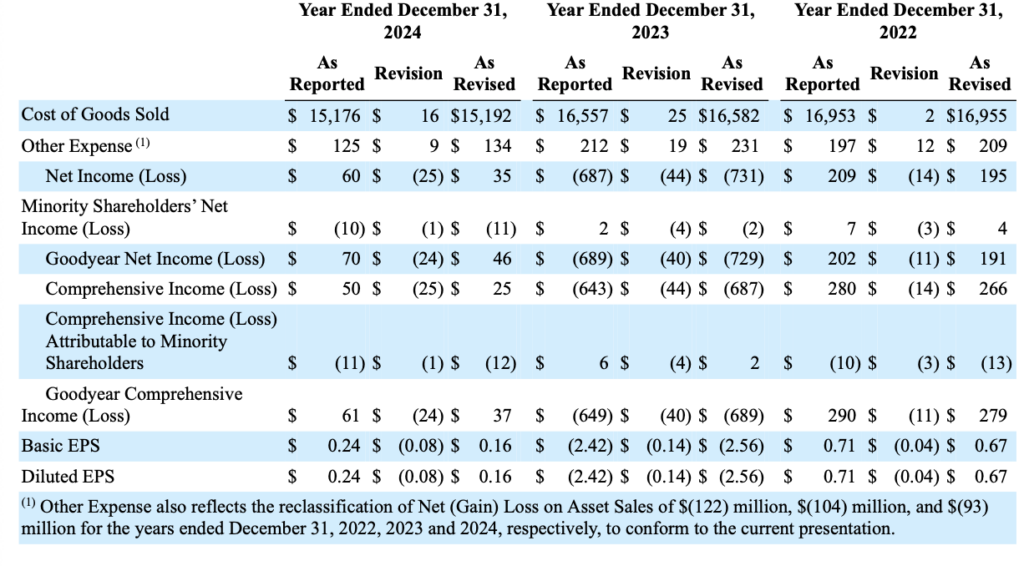
The following tables reflect the impact of the revision to the specific line items presented in our previously reported financial information.

Impacts to Consolidated Statements of Operations and Comprehensive Income (in millions, except per share data)

As you might expect with this type of revision, the SEC asked Goodyear about related ICFR implications in a comment letter dated September 10, 2025:

Form 10-Q for the Period Ended June 30, 2025

Notes to Consolidated Financial Statements

Note 16. Revision of Previously Issued Financial Statements, page 33

    1. We note your disclosure that you identified and corrected immaterial errors related to your historical presentation of your foreign operations in Turkey. Please tell us further details of the error, including, but not limited to, a discussion of who identified the error, when, and how, and whether it was the result of any control deficiency. In your response ensure you include a thorough discussion and description of the control deficiency to the extent one was identified, the Company’s evaluation of whether it was a control deficiency, significant deficiency, or material weakness, and any remediation plans. To the extent the Company concluded there was not a control deficiency, tell us why.

As you can read in the company’s September 23, 2025 response letter, Goodyear explained that the error was identified during second-quarter 2025 close procedures. The issue arose from a manual process used to remeasure inventory and accounts payable balances in Turkey following that country’s designation as highly inflationary.

Management concluded that the root cause was a design deficiency—specifically, the lack of an effectively designed control to verify that manually translated balances agreed to the general ledger.

Importantly, Goodyear evaluated the deficiency under the SEC’s internal control framework and concluded:

  • The deficiency was limited to Turkey, which represented approximately 2% of consolidated revenues and less than 1% of consolidated assets in the affected years.
  • The impact was confined to inventory and accounts payable in Turkey.
  • It was not reasonably possible that the potential misstatement could be larger than the actual error identified.
  • There were no broader indicators of pervasive control failures or fraud.

Based on this analysis, the company determined that the issue constituted a significant deficiency, but not a material weakness, and that its internal control over financial reporting remained effective.

Goodyear also implemented a remediation plan that included redesigning the balance sheet remeasurement control to calculate translated Turkey balances and agree them to the U.S. dollar general ledger.

Following its review of Goodyear’s response, the SEC did not issue additional comments. In other words, the Staff accepted the company’s internal control conclusions.

For practitioners, this comment letter underscores the importance of documenting complex judgments contemporaneously and thoroughly.

As always, your thoughts and comments are welcome!

When Might a Computer System Upgrade Be Material?

The reporting requirements for material changes in ICFR apply to both Forms 10-K and 10-Q and are contained in Regulation S-K Item 308(c):

(c) Changes in internal control over financial reporting. Disclose any change in the registrant’s internal control over financial reporting identified in connection with the evaluation required by paragraph (d) of § 240.13a-15 or 240.15d-15 of this chapter that occurred during the registrant’s last fiscal quarter (the registrant’s fourth fiscal quarter in the case of an annual report) that has materially affected, or is reasonably likely to materially affect, the registrant’s internal control over financial reporting.

The materiality of some changes in ICFR is fairly easy to determine, such as when a material weakness arises and ICFR goes from effective to ineffective.  But this is not always the case.  For example, determining whether installation of a new or upgraded system creates a material change in ICFR can be a complex and subjective judgment.  This type of change in ICFR is addressed in Question 7 of these Sarbanes-Oxley C&DIs:

After the registrant’s first management report on internal control over financial reporting, pursuant to Item 308 of Regulations S-K or S-B, the registrant is required to identify and disclose any material changes in the registrant’s internal control over financial reporting in each quarterly and annual report. This would encompass disclosing a change (including an improvement) to internal control over financial reporting that was not necessarily in response to an identified material weakness (i.e. the implementation of a new information system) if it materially affected the registrant’s internal control over financial reporting. Materiality, as with all materiality judgments in this area, would be determined upon the basis of the impact on internal control over financial reporting and the materiality standard articulated in TSC Industries, Inc. v. Northway, Inc. 426 U.S. 438 (1976) and Basic Inc. v. Levinson, 485 U.S. 224 (1988).

Lamb Weston Holdings, Inc. provided an example of the issues surrounding this disclosure.  The company is a global producer, distributor, and marketer of frozen potato products. According to the company’s Form 10-K, french fries represent most of their “value-added frozen potato product portfolio.”  On April 3, 2024, Lamb Weston’s stock closed at $101.12.  The next day, on April 4, 2024, the stock closed at $81.53.  Behind this sudden stock drop was this Form 8-K for the company’s third quarter earnings release.  (The company’s third quarter ended on February 25, 2024.)  In the release the company disclosed:

ERP Transition

At the beginning of the fiscal third quarter, the Company transitioned certain central systems and functions, including order to cash, produce to deliver, source to pay, and inventory management, among others in North America to a new ERP system. After the transition, the Company experienced reduced visibility into finished goods inventories at its distribution centers, resulting in a higher-than-expected effect on customer order fulfillment rates. The transition had a greater impact on shipments of higher-margin mixed-product loads than shipments of single-product orders, resulting in unfavorable mix. The Company partnered closely with its customers to minimize the impact and estimates the lower order fulfillment rates reduced sales volume growth by approximately 8 percentage points and net sales by approximately $135 million during the fiscal third quarter, with $123 million and $12 million in the Company’s North America and International segments, respectively.

In total, the Company estimates the ERP transition negatively impacted fiscal third quarter net income by approximately $72 million, and Adjusted EBITDA by approximately $95 million.

Lamb Weston had identified the risks associated with their ERP system transition and included this risk factor in their Form 10-K for their fiscal year ended May 28, 2023:

Problems with the transition, design, or implementation of our new ERP system could interfere with our business and operations and adversely affect our financial condition.

We are in the process of building a new ERP system to replace our existing operating and financial systems. The ERP system is designed to accurately maintain our financial records, enhance operational functionality, and provide timely information to our management team related to the operation of the business. The ERP system implementation process has required, and will continue to require, the investment of significant personnel and financial resources. Due to the uncertainty caused by COVID-19, we paused ERP work in fiscal 2021, after completing the first phase of implementation. We have resumed designing the next phase of our ERP implementation of central functions in North America and are in the test stage. We expect to begin implementing this next phase in fiscal 2024. We have experienced, and may continue to experience, difficulties as we transition to new upgraded systems and business processes. These difficulties have or may include loss of data; difficulty in making payments to third-parties; difficulty in completing financial reporting and filing reports with the SEC in a timely manner; or challenges in otherwise running our business. We may also experience decreases in productivity as our personnel implement and become familiar with new systems and processes. Any disruptions, delays, or deficiencies in the transition, design, and implementation of a new ERP system, particularly any disruptions, delays, or deficiencies that impact our operations, could have a material adverse effect on our business, financial condition, and results of operations. Even if we do not encounter adverse effects, the transition, design, and implementation of a new ERP system, may be much more costly than we anticipated.

As discussed above, whether or not a computer system change is “material” can be a complex judgment.  That said, if a change could be “reasonably likely” to materially affect ICFR, it should be disclosed.  Obviously, we are looking at Lamb Weston’s situation with hindsight, but many times it is better to be conservative in deciding whether to make this kind of disclosure.  Lamb Weston included this disclosure in their third quarter Form 10-Q:

Changes in Internal Control over Financial Reporting

Our management, with the participation of our Chief Executive Officer and Chief Financial Officer, evaluated any change in our internal control over financial reporting (as defined in Rule 13a-15(f) under the Exchange Act) that occurred during the quarter ended February 25, 2024. During the quarter ended February 25, 2024, we transitioned certain central systems and functions, including order to cash, produce to deliver, source to pay, and inventory management, among others, in North America to a new enterprise resource planning (“ERP”) system, as part of our multi-year effort to upgrade our information systems and ERP infrastructure across the Company. This implementation included changes to certain financial processes impacting key controls related to our internal controls over financial reporting. We have updated our internal controls as appropriate in light of the system implementation and will continue to monitor the impact of the implementation on our processes, procedures, and internal control over financial reporting.

As always, your thoughts and comments are welcome!
A Workshop for Foreign Private Issuers and Their Advisors

Foreign private issuer (FPI) reporting is a hot topic in the world of SEC reporting.  Congress recently enacted the Holding Foreign Issuers Accountable Act requiring directors and officers of FPIs to comply with Section 16(a) reporting requirements.  These individuals will be required to file Forms 3, 4 and 5 starting on March 18, 2026.  In addition, as discussed in this Concept Release, the SEC is reconsidering the FPI definition.  Possible changes may result in some companies losing their FPI status and being required to transition to the domestic registrant reporting regimen.

To help FPIs and their advisors prepare for these and other possible changes, our Form 20-F and Foreign Private Issuer In-Depth Workshop will be presented on January 12-13, 2026, at PLI’s New York Conference Center.  You can attend in person or online and learn  more about the workshop here.

As always, your thoughts and comments are welcome!

Register Now for SECI’s One-Hour Briefing: “Navigating a Financial Restatement in SEC Reporting”

On June 11, 2025, the former hosts of PLI’s InSecurities podcast, Chris Ekimoff of RSM US LLP and Kurt Wolfe of Quinn Emanuel Urquhart & Sullivan, LLP, along with George Wilson of PLI’s SEC Institute, will present a One-Hour Briefing titled “Navigating a Financial Restatement in SEC Reporting.”  Companies are frequently unprepared for, and even unaware of, the risks when a financial reporting error is discovered.  This briefing will help companies build a plan and be ready if they ever need to navigate the restatement process.

This briefing will address:

    • First steps: how to respond after discovering a financial statement error
    • The audit committee’s role in the restatement process
    • Critical steps in the investigation process
    • How to develop a strategy to communicate with the SEC
    • How to control the narrative
    • Reporting restatements in Forms 10-K/A and 10-Q/A
    • When to claw back incentive-based compensation

As always, your thoughts and comments are welcome!

An Example Cybersecurity Event Form 8-K

On April 12, 2025, Davita, Inc. reported a cybersecurity attack on Form 8-K.  Interestingly, and appropriately, the company did not report the event on Item 1.05.  The instructions for Item 1.05 begin with:

Item 1.05 Material Cybersecurity Incidents.

(a) If the registrant experiences a cybersecurity incident that is determined by the registrant to be material, describe the material aspects of the nature, scope, and timing of the incident, and the material impact or reasonably likely material impact on the registrant, including its financial condition and results of operations.

As this instruction clearly states, this Form 8-K Item is for material cybersecurity incidents.  That said, many times a company will want to alert investors and others when a cybersecurity incident has occurred, but the company is still in the process of assessing the materiality of the event.  On May 21, 2024, CorpFin issued this Statement addressing how to report a cybersecurity event before a materiality assessment is complete.  In the Statement, CorpFin “encourages” companies to use a different Form 8-K Item, perhaps Item 8.01 or 7.01.

Davita’s Form 8-K was filed under Item 8.01 and includes this language:

Item 8.01. Other Events. 

On April 12, 2025, DaVita Inc. (the “Company” or “we”) became aware of a ransomware incident that has encrypted certain elements of our network. Upon discovery, we activated our response protocols and implemented containment measures, including proactively isolating impacted systems. We are actively working to assess and remediate the incident with the assistance of third-party cybersecurity professionals and have notified law enforcement of the matter.

We have implemented our contingency plans, and we continue to provide patient care. However, the incident is impacting some of our operations, and while we have implemented interim measures to allow for the restoration of certain functions, we cannot estimate the duration or extent of the disruption at this time.

Given the recency of the incident, our investigation and response are ongoing, and the full scope, nature, and potential ultimate impact on the Company are not yet known.

As a final note, remember that Form 8-K Item 8.01 is filed information and Item 7.01 is only furnished.  Careful consideration should be given as to whether a company wants this information to be furnished or filed.

As always, your thoughts and comments are welcome!

SECI’s Period-End Reporting Programs – Register Now!

As we approach December 31, 2024, SECI is presenting several One-Hour Briefings focused on period-end reporting:

Eleventh Annual Form 10-K/Proxy Tune-Up – December 9, 2024

Tenth Annual Dealing With MD&A Hot Topics  – December 10, 2024

Fifth Annual Form 20-F Tune-Up – February 14, 2025

Fifth Annual Disclosure Committee Tune-Up – January 28, 2025

SECI’s Annual SEC Reporting and FASB Forum (the 40th edition!), is another great resource for keeping current with new rules and regulations emanating from the SEC, FASB, and PCAOB as you prepare for year end.  Attend in-person or view the webcasts scheduled for December 5-6, 2024, in San Francisco and December 19-20, 2024, in New York.

Also be sure to check out SECI’s One-Hour Briefing series focused on frequent SEC comment areas:

SEC Management’s Discussion and Analysis Comments (on-demand)

SEC Non-GAAP Measures and Metrics Comments (on-demand)

SEC Operating Segment Comments (on-demand)

SEC Revenue Recognition Comments (on-demand)

SEC Climate-Related Comments – December 2, 2024

Lastly, be sure to visit our Blog often as we will be exploring frequently encountered problems in Forms 10-K and 20-F in an upcoming series.

To view SECI’s full  curriculum, including our new Operating Segment Disclosures Workshop and our comprehensive two-day SEC Reporting Skills for Financial Professionals, visit us at: https://www.pli.edu/programs/seci

As always, your thoughts and comments are welcome!

ICFR Reporting and Acquisitions

In the year a company completes an acquisition, ICFR reporting for the combined business can be problematic.  If the acquired company has been private, or has not built an ICFR evaluation process, it may not be practicable to include the acquired business in the acquiror’s assessment of ICFR, and, if applicable, in the auditor’s attestation report over ICFR.  This is particularly true when an acquisition happens near year end.

Interestingly, this situation is addressed not in Regulation S-X, but in a Sarbanes-Oxley C&DI:

Question 3 

Q: If a registrant consummates a material purchase business combination during its fiscal year, must the internal control over financial reporting of the acquired business be included in management’s report on internal control over financial reporting for that fiscal year?

A: As discussed above, we would typically expect management’s report on internal control over financial reporting to include controls at all consolidated entities. However, we acknowledge that it might not always be possible to conduct an assessment of an acquired business’s internal control over financial reporting in the period between the consummation date and the date of management’s assessment. In such instances, we would not object to management referring in the report to a discussion in the registrant’s Form 10-K or 10-KSB regarding the scope of the assessment and to such disclosure noting that management excluded the acquired business from management’s report on internal control over financial reporting. If such a reference is made, however, management must identify the acquired business excluded and indicate the significance of the acquired business to the registrant’s consolidated financial statements. Notwithstanding management’s exclusion of an acquired business’s internal controls from its annual assessment, a registrant must disclose any material change to its internal control over financial reporting due to the acquisition pursuant to Exchange Act Rule 13a-15(d) or 15d-15(d), whichever applies (also refer to the last two sentences in the answer to question 7). In addition, the period in which management may omit an assessment of an acquired business’s internal control over financial reporting from its assessment of the registrant’s internal control may not extend beyond one year from the date of acquisition, nor may such assessment be omitted from more than one annual management report on internal control over financial reporting.

On February 28, 2023, Lamb Weston Holdings, Inc., a global producer, distributor, and marketer of frozen potato products, acquired LW EMEA, an entity previously accounted for using the equity method.  Item 9A in the company’s Form 10-K for their fiscal year ended May 28, 2023, included this disclosure about the exclusion of the acquired company from the ICFR evaluation:

Our management, under the supervision and with the participation of our Chief Executive Officer and Chief Financial Officer and oversight of the Board of Directors, assessed the effectiveness of our internal control over financial reporting as of May 28, 2023. Management based this assessment on criteria for effective internal control over financial reporting described in Internal Control – Integrated Framework (2013) issued by the Committee of Sponsoring Organizations of the Treadway Commission. Management’s assessment included evaluation of elements such as the design and operating effectiveness of key financial reporting controls, process documentation, accounting policies, and our overall control environment. Management’s assessment of internal control over financial reporting as of May 28, 2023 excludes internal control over financial reporting related to LW EMEA (acquired February 28, 2023), which accounted for 7% of consolidated net sales and 30% of consolidated total assets as of and for the year ended May 28, 2023. Based on this assessment, management concluded that, as of May 28, 2023, our internal control over financial reporting was effective to provide reasonable assurance regarding the reliability of financial reporting and the preparation of consolidated financial statements for external reporting purposes in accordance with GAAP. We reviewed the results of management’s assessment with the Audit and Finance Committee of our Board of Directors.

As always, your thoughts and comments are welcome!